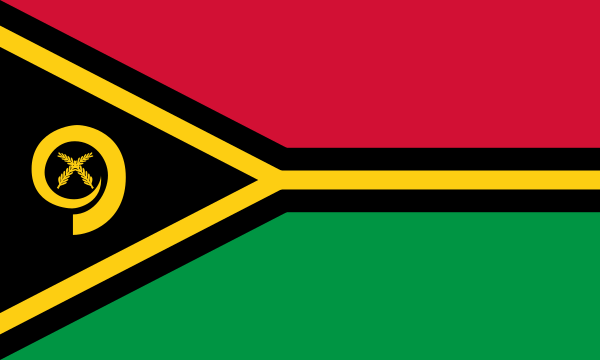
Flag of the Republic of Vanuatu
Description
- Red over green field with a black triangle at the hoist and a yellow Y-shaped stripe edged in black running horizontally and into the triangle; a yellow boar's tusk encircling two crossed yellow namele leaves sits inside the triangle
- Adopted on 30 July 1980 at independence from the Anglo-French condominium
Colors in detail
| Color | RGB Hex |
|---|---|
| Red | #ce1126 |
| Represents the blood of boars and humans and the unity of the ni-Vanuatu people | |
| Green | #009543 |
| Represents the country's fertile islands | |
| Black | #000000 |
| The triangle at the hoist and the fimbriations representing the Melanesian people | |
| Yellow | #ffce00 |
| The Y-shaped stripe and central emblem representing the Christian faith shining through the islands | |
Trivia
- The Y-shape reflects the rough geographic layout of the main islands and also represents the light of Christianity spreading through the archipelago
- The boar's tusk is a traditional symbol of prosperity worn as a pendant across much of Vanuatu
- The two crossed namele fern leaves traditionally signify peace; their 39 fronds recall the 39 members of the first parliament
Flag of Vanuatu
Vanuatu adopted its flag on 30 July 1980 at independence from the Anglo-French condominium that had jointly governed the archipelago as the New Hebrides. The design splits the field horizontally into red over green, overlaid with a black triangle at the hoist and a yellow Y-shaped stripe edged in black that runs across the flag into the triangle.
Red represents the blood of boars and humans and the unity of the ni-Vanuatu people, green stands for the fertile islands, and black honours the Melanesian population. The yellow Y echoes the rough geographical arrangement of the main islands and the spread of Christianity through them. Inside the triangle a yellow boar's tusk — a traditional emblem of prosperity — encircles two crossed namele fern fronds that signify peace.
json:data
{
  "g": "nf,oceania",
  "ns": "vanuatu",
  "id": "vanuatu",
  "index": "c/vanuatu",
  "title": "Flag of the Republic of Vanuatu",
  "ratio": "11:18",
  "colors": [
    {
      "color": "red",
      "hex": "#CE1126",
      "note": "Represents the blood of boars and humans and the unity of the ni-Vanuatu people"
    },
    {
      "color": "green",
      "hex": "#009543",
      "note": "Represents the country's fertile islands"
    },
    {
      "color": "black",
      "hex": "#000000",
      "note": "The triangle at the hoist and the fimbriations representing the Melanesian people"
    },
    {
      "color": "yellow",
      "hex": "#FFCE00",
      "note": "The Y-shaped stripe and central emblem representing the Christian faith shining through the islands"
    }
  ],
  "desc": "- Red over green field with a black triangle at the hoist and a yellow Y-shaped stripe edged in black running horizontally and into the triangle; a yellow boar's tusk encircling two crossed yellow namele leaves sits inside the triangle\n - Adopted on 30 July 1980 at independence from the Anglo-French condominium\n",
  "article": "vanuatu/flag.md",
  "use": {
    "as": "national flag",
    "since": "1980-07-30"
  },
  "of": {
    "country": "vanuatu"
  },
  "countryData": {
    "name": "Vanuatu",
    "officialName": "Republic of Vanuatu",
    "continent": "oceania",
    "location": "Melanesia, South Pacific",
    "un": "member"
  },
  "trivia": "- The Y-shape reflects the rough geographic layout of the main islands and also represents the light of Christianity spreading through the archipelago\n - The boar's tusk is a traditional symbol of prosperity worn as a pendant across much of Vanuatu\n - The two crossed namele fern leaves traditionally signify peace; their 39 fronds recall the 39 members of the first parliament\n",
  "flag": "vanuatu/flag.svg",
  "_name": "Vanuatu",
  "_namespace": "vanuatu",
  "_namePart": ""
}